The Memento: Using AI to Preserve Home Through Artistic Transformation
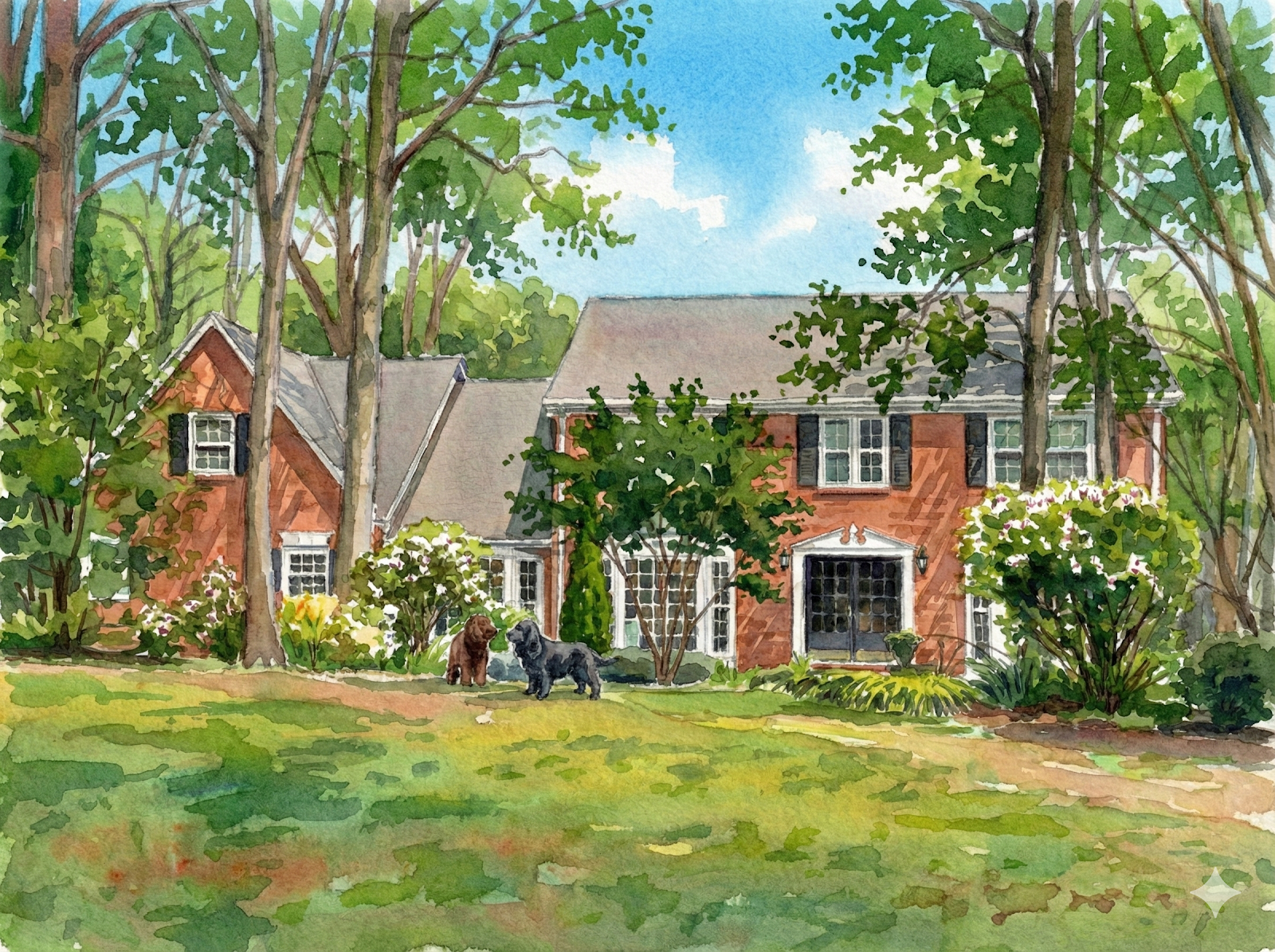
Using AI vision models, upscaling workflows, and traditional printing, we transformed a photograph of our parents' home into a museum-quality watercolor painting—a 9600x7168 pixel artifact printed at 18"x24" and framed as a memento of 25 years of family life in one place. The project merges computational creativity with intentional curation, proving that technical mastery becomes meaningful only when it serves something worth preserving.

Introduction
When a family leaves behind 25 years of accumulated memory, a photograph alone cannot capture what that house meant. Neither can nostalgia. What's needed is transformation—taking the raw material of a space and elevating it through both technical precision and artistic vision until it becomes something that speaks to the ineffable: the countless moments that shaped who we became.
This project combines computational creativity with deliberate human intent. It's work that sits at the intersection where the medieval scholar and the Renaissance artist would have recognized each other—where technical mastery serves as the vehicle for meaning-making.
The Problem Statement
A house is not architecture. It's the accumulated weight of 25 years of mornings, arguments, celebrations, quiet breakfasts, late-night conversations, and the simple fact of being together in one place. When your parents leave that house, a digital photograph preserves information but destroys context. It's too literal. Too flat. It doesn't translate the experience into something that can be hung on a wall and felt.
The challenge: transform a photograph into something that honors both the specificity of the place and the emotional density it carries. Something that acknowledges its source material while transcending it.
The Technical Pipeline
Stage 1: Artistic Transformation via Gemini Vision
The first step required surrendering literal representation. Using Google's Gemini model with vision capabilities, we submitted the photograph of the home and requested it be converted into a watercolor painting.
This wasn't arbitrary—watercolor exists in a liminal space between representation and abstraction. It's technically demanding (you can't undo brushstrokes), yet it permits softness, ambiguity, and emotional suggestion alongside accurate detail. It's the medium Renaissance artists would have used to paint what they felt about a place, not merely what they saw.
Gemini's output provided the foundation: a digitally-rendered watercolor that captured the essential character of the home while introducing the painterly quality necessary for emotional resonance.
Stage 2: Resolution Engineering via Upscaling
The watercolor output from Gemini, while aesthetically successful, was limited in resolution. The intended final print—18" x 24"—demanded exceptional quality. This required multiple upscaling passes:
Upscayl served as the primary workhorse. It applies AI-trained models (primarily Real-ESRGAN and similar architectures) to intelligently reconstruct detail and sharpness without introducing hallucinated artifacts. Each pass multiplies resolution while attempting to preserve the watercolor aesthetic we'd intentionally created.
ComfyUI workflows provided fine-grained control over the upscaling process. Rather than applying a single monolithic upscale operation, ComfyUI allowed us to chain multiple specialized nodes:
- Tile processing to handle edge artifacts in large upscales
- Chained denoisers to maintain stroke integrity
- Selective sharpening masks to emphasize architectural detail while preserving painterly softness
The workflow approach is crucial here. It's the difference between applying an effect and sculpting a result. Each node becomes a decision point—where technical parameters transform into aesthetic choices.
The final resolution achieved: 9600 x 7168 pixels. This exceeds industry standards for a 18" x 24" print by a significant margin, ensuring that when viewed at normal distance, no pixelation or upscaling artifacts would be perceptible. The image could withstand scrutiny.
Stage 3: Physical Manifestation via Vistaprint
Resolution without printing is abstraction. Vistaprint's service converted the digital artifact into physical matter—an 18" x 24" poster printed on quality stock. The scale matters. Large enough to command attention. Small enough to fit meaningfully in a room. The dimensions create a presence without overwhelming.
Then came framing—the final act of curation. The frame transforms the print from product into artifact. It says: this matters enough to preserve carefully.
The Philosophical Substrate
There's a reason medieval scholars and Renaissance artists were indistinguishable. Both operated from the same conviction: that the act of transformation reveals truth.
The scholar transcribed texts. The act of copying forced engagement with every word, every concept. Knowledge wasn't passive reception—it was making. The scholar's hand shaped understanding.
The artist painted. Not to replicate the world mechanically (that's what cameras do now), but to excavate meaning from observation. To ask: what matters about this scene? What emotions live here? What should be emphasized? What can be suggested rather than stated?
This project inherits both traditions.
We didn't simply frame a photograph. We transformed it through:
- Gemini's translation from photography into painterly interpretation (asking: what is the emotional essence of this space?)
- Upscaling workflows that amplified detail while preserving aesthetic intention (asking: how do we honor the artistic choice while enabling physical scale?)
- Curation and framing that converts digital abstraction into a object worthy of sustained attention
Each step required judgment. Each step asked not "what is technically possible?" but "what will this communicate to people who know this house intimately?"
What Was Actually Created
A watercolor painting exists in a state of permanent incompleteness. It invites the viewer's mind to complete what pigment suggests. The soft edges of the house merge slightly with the sky. The trees are indicated rather than itemized. The whole thing admits that 25 years cannot be documented—it can only be suggested.
At 9600 x 7168, that suggestion becomes sustainable at scale. You can stand a foot away and the image holds. The brushwork remains visible. The watercolor texture survives.
Hung in their new home, it becomes an anchor. Not a tether to the past (that would be unhealthy), but an acknowledgment: this was real. This mattered. We were there together.
Why This Matters Beyond the Technical
The gift succeeds because it operates simultaneously at multiple levels:
Technically, it demonstrates that computational creativity—used with intention—can enhance rather than replace human meaning-making. Gemini didn't create the emotional resonance; it translated it. The upscaling didn't flatten the result; it amplified it.
Artistically, it honors the principle that transformation of materials is how we communicate what matters. You don't frame a house photograph because the photograph doesn't mean anything. You transform it because transformation is how human beings have always said: this is significant. I've invested craft into preserving this moment.
Emotionally, it acknowledges that places aren't fungible. Twenty-five years in one house creates a specific gravity. A digital file respects that. A physical, beautifully printed and framed artifact respects it further.
Conclusion
The medieval scholar understood something we sometimes forget in our age of instant reproduction: that the act of creating, transforming, and carefully preserving something is itself a form of meaning.
This project took modern computational tools and applied them with the intention of the Renaissance artisan. Not to replace human judgment, but to amplify it. To say: your home mattered enough to transform carefully. Your memories are worth printing at scale. Your life in that house deserves to be memorialized not as documentation, but as art.
The technical pipeline is reproducible. The emotional payload is not. But they work together because they always have—since the first scholar drew a careful margin note, since the first artist mixed pigments to capture not what they saw, but what they understood.
That's what sits on your parents' wall now. Not a photograph. A transformation. A statement made in pixels, paint, and care.